
Garment Production Workflow: Step-by-Step Guide from Design to Delivery
A single late trim, a missed fabric test, or an unbalanced sewing line can delay an entire shipment. The garment production workflow is the backbone of every successful apparel business. It turns a sketch into thousands of consistent, export-ready garments, on time and within budget.
This guide covers each stage of the garment manufacturing process, the checkpoints that protect quality, and proven ways to shorten lead times and reduce costs. It suits brand owners, merchandisers, production managers, and sourcing professionals.
What Is a Garment Production Workflow?
A garment production workflow is the structured sequence of activities that convert a design concept into finished, packed apparel. It runs from product development and sourcing through cutting, sewing, finishing, inspection, and shipping.
A well-defined workflow delivers:
- Predictable lead times and on-time delivery
- Consistent quality across every size and batch
- Lower waste in fabric, labor, and energy
- Clear accountability between departments
- Better buyer confidence and repeat orders
Garment Production Workflow at a Glance
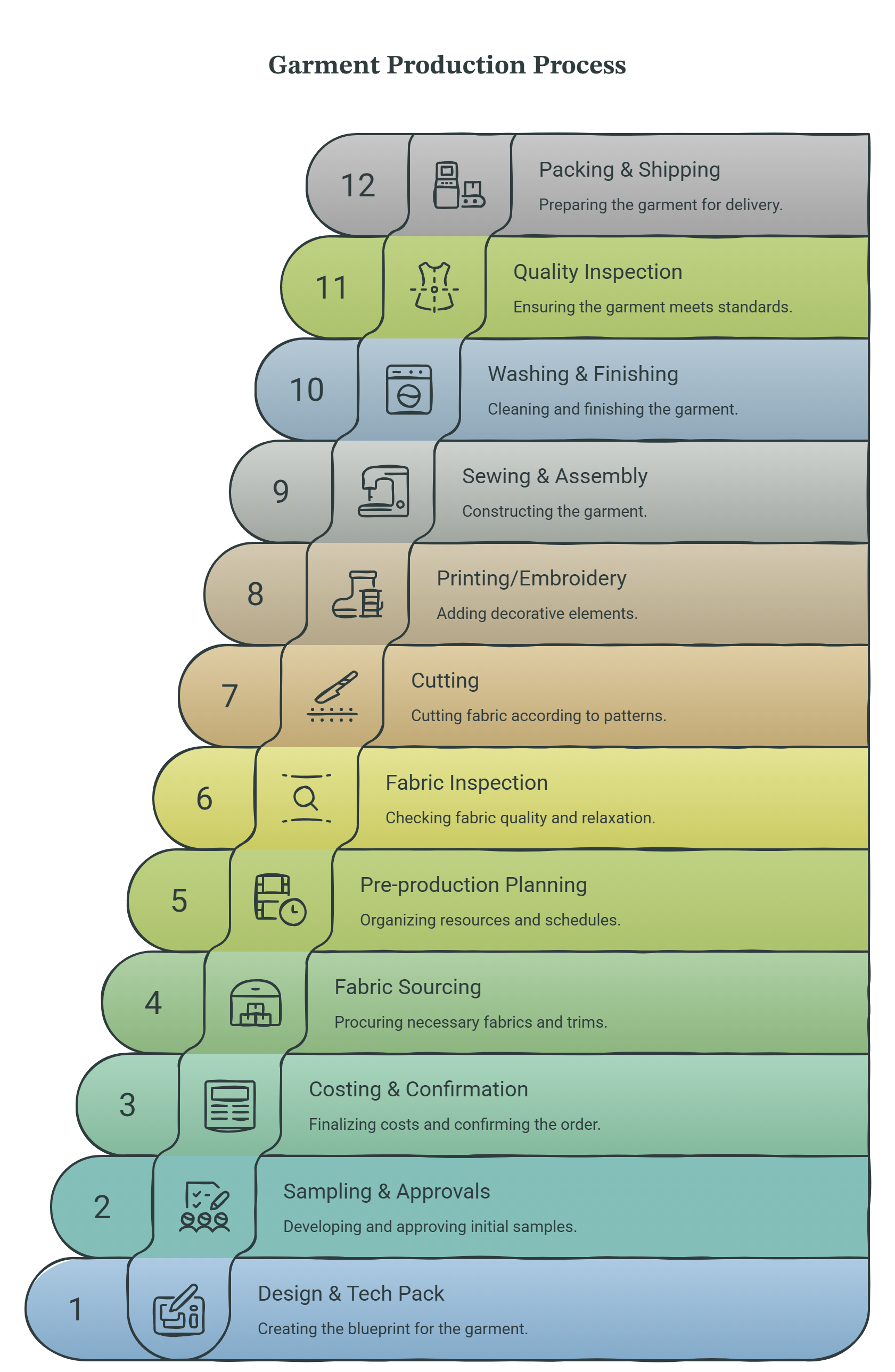
Stage 1: Design Development and Tech Pack Creation
Every garment begins as an idea, whether a sketch, a mood board, or a reference sample. The design team translates it into a tech pack (technical package), the master document for the whole workflow.
A strong tech pack includes:
- Flat sketches with front, back, and detail views
- Bill of materials (BOM) listing fabrics, threads, buttons, zippers, labels
- Size chart and grading specifications
- Point-of-measure (POM) tolerances
- Stitch types, seam allowances, and construction notes
- Artwork, print placement, and Pantone color references
- Packing and labeling instructions
Pro tip: Most production errors trace back to unclear tech packs. Time spent here saves multiples downstream.
Stage 2: Sampling and Product Development
Sampling proves that the design can be manufactured to spec. Typical sample types include:
- Proto sample: first check of fit and construction
- Fit sample: evaluates size, drape, and comfort on a fit model
- Sales / salesman sample (SMS): used for buyer presentations
- Pre-production (PP) sample: the final approved reference before bulk begins
- Top-of-production (TOP) sample: pulled from the first bulk output to confirm consistency
Each round generates comments, corrections, and approvals. Fast, well-documented feedback loops are one of the biggest levers for reducing garment lead time.
Stage 3: Costing and Order Confirmation
Once samples are approved, merchandisers calculate the garment cost covering fabric consumption, trims, CM (cut-and-make) charges, wash, packing, testing, freight, and margin.
Accurate fabric consumption estimates are critical because fabric often represents the largest share of the total cost. After price negotiation, the buyer issues a purchase order (PO) and the production timeline is locked.
Stage 4: Fabric and Trim Sourcing
Raw materials drive both quality and delivery. The sourcing team:
- Places fabric and trim orders based on the approved BOM
- Requests lab dips and strike-offs for color approval
- Runs physical and chemical tests (shrinkage, colorfastness, GSM, pilling)
- Tracks in-house dates against the Time and Action (T&A) calendar
Late trims, such as labels, zippers, or hang tags, are among the most common causes of shipment delays, so they deserve the same attention as fabric.
Stage 5: Pre-Production Planning and PP Meeting
Before a single piece is cut, the factory holds a pre-production meeting with merchandising, production, quality, and sometimes the buyer. The agenda covers:
- Approved sample review and critical quality points
- Line loading and capacity planning
- Machine and skill requirements
- Risk points, such as difficult fabrics or complex operations
- Final T&A confirmation
This step aligns everyone and prevents avoidable rework.
Stage 6: Fabric Inspection and Relaxation
Incoming fabric is checked using systems like the 4-point inspection method to detect weaving flaws, holes, stains, and shade variation. Knit fabrics are typically relaxed before cutting so they can recover from tension and reduce post-wash shrinkage or distortion.
Catching defects at this stage costs far less than finding them after sewing.
Stage 7: Marker Making, Spreading, and Cutting
The cutting room is where fabric utilization is won or lost.
- Marker making: patterns are arranged to minimize waste, often using CAD software to improve marker efficiency
- Spreading: fabric is laid in plies with correct tension, alignment, and grain direction
- Cutting: straight knives, band knives, or automated cutters produce panels
- Numbering and bundling: each cut piece is tagged to prevent shade mixing and size errors
Even a 1% improvement in fabric utilization can create significant savings on large orders.
Stage 8: Printing, Embroidery, and Embellishment
If the design requires screen printing, digital printing, embroidery, or appliqué, this step usually occurs on cut panels before sewing. Careful placement checks and wash-fastness testing are essential to avoid costly rejects on nearly finished garments.
Stage 9: Sewing and Assembly
Sewing is the most labor-intensive stage of the apparel production process. Efficient factories use:
- Line balancing to distribute operations evenly and avoid bottlenecks
- Operation breakdown (OB) to define every step, machine, and standard minute value (SMV)
- Progressive bundle or modular systems depending on the product
- Inline quality checks at critical operations, such as collars, plackets, and waistbands
Key sewing KPIs include efficiency percentage, defects per hundred units (DHU), and daily output against target.
Stage 10: Washing, Finishing, and Pressing
After sewing, garments may go through washing (enzyme, stone, garment dye, or softener treatments), followed by:
- Thread trimming and spot cleaning
- Pressing or steaming
- Measurement checks against the spec sheet
- Tagging, labeling, and folding
Consistent wash recipes and controlled processes protect color, hand-feel, and dimensional stability.
Stage 11: Garment Quality Control and Final Inspection
Garment quality control runs through the entire workflow, not only at the end. The main checkpoints are:
- Incoming inspection: fabric and trims
- Inline inspection: during sewing
- Endline inspection: at the end of each sewing line
- Final random inspection: typically based on AQL (Acceptable Quality Limit) sampling, commonly AQL 2.5 for major defects, though buyers set their own levels
Common defects to watch for include open seams, skipped stitches, uneven hems, shade variation, stains, and measurement out-of-tolerance.
Stage 12: Packing, Documentation, and Shipping
The final stage prepares goods for the buyer:
- Folding, polybagging, and carton packing per buyer instructions
- Barcode, size ratio, and carton marking verification
- Packing lists, commercial invoices, and certificates of origin
- Booking freight and coordinating with forwarders
- Customs clearance and export documentation
Errors here, such as wrong size ratios or mislabeled cartons, can cause chargebacks even when the garments themselves are perfect.
Common Bottlenecks in the Garment Production Workflow
- Delayed sample approvals and unclear buyer comments
- Late arrival of fabric or trims
- Poor line balancing and frequent style changeovers
- Inaccurate fabric consumption estimates
- Rework caused by inadequate inline quality checks
- Weak communication between merchandising and production
How to Optimize Your Garment Production Workflow
- Standardize your tech packs with templates so nothing is missed.
- Use a T&A calendar with real-time tracking and early-warning alerts.
- Adopt ERP or PLM software for centralized data, approvals, and reporting.
- Invest in skills training for operators and line supervisors.
- Shift quality upstream by catching defects early rather than at final inspection.
- Improve marker efficiency with CAD and consumption audits.
- Apply lean manufacturing principles such as 5S, kaizen, and waste elimination.
- Track KPIs weekly: on-time delivery, DHU, line efficiency, and fabric utilization.
Trends Shaping Modern Garment Production
- Digital product development: 3D design and virtual sampling reduce physical sample rounds.
- Automation: automated cutting, spreading, and sewing aids improve consistency.
- Traceability: RFID and digital tracking give visibility from fabric to shipment.
- Sustainability: buyers increasingly expect responsible sourcing, water-saving wash processes, and lower waste.
- Nearshoring and flexibility: shorter runs and faster replenishment are reshaping order patterns.
Frequently Asked Questions
How long does the garment production process take?
Timelines vary widely by product complexity, order size, and material availability. Simple styles may take several weeks from fabric in-house to shipment, while complex orders with sampling, washing, and embellishment can take a few months.
What is the difference between a tech pack and a sample?
A tech pack is the written and visual specification, while a sample is the physical garment made from it. The tech pack guides the sample, and the approved sample guides bulk production.
What does AQL mean in garment inspection?
AQL (Acceptable Quality Limit) is a statistical sampling standard that defines the maximum number of defective pieces allowed in a random sample for a lot to pass inspection.
How can a factory reduce garment production lead time?
Faster approvals, accurate T&A planning, early trim booking, balanced sewing lines, and inline quality control are the most effective levers.
Why is the pre-production meeting important?
It aligns all departments on specifications, risks, and timelines before cutting begins, which prevents costly mistakes in bulk.
At The End
A strong garment production workflow is a system of clear handoffs, early quality control, and disciplined planning, not just a list of steps. Brands and factories that invest in accurate tech packs, structured sampling, proactive sourcing, and data-driven line management deliver better quality, faster turnaround, and stronger buyer relationships.
For international apparel buyers sourcing from Bangladesh, working with an experienced sourcing partner can simplify supplier communication and production management while providing greater visibility throughout the manufacturing process.
Start by mapping your current workflow, identifying where delays and rework occur, and improving one stage at a time. The gains compound quickly.
ELITE SOURCING BD supports global buyers with structured apparel sourcing and production coordination in Bangladesh, helping turn product concepts into professionally manufactured garments.
Ready to Start Your Garment Sourcing Project?
Connect with ELITE SOURCING BD to discuss your product requirements, sourcing needs, production quantities, quality expectations, and delivery timeline.