
For international fashion brands, minimum order quantity (MOQ) can be one of the biggest obstacles when sourcing apparel from Bangladesh.
A buyer may have a strong product concept, an approved tech pack and a realistic sales forecast—only to discover that the selected factory requires a much larger order than planned.
The immediate reaction is often:
“Can you reduce the MOQ?”
Sometimes the answer is yes.
But simply asking a factory to lower its minimum quantity is rarely the most effective negotiation strategy.
The better approach is to understand why the factory has that MOQ in the first place and then change the underlying economics.
In Bangladesh apparel manufacturing, MOQ can be influenced by:
- Fabric minimums
- Dyeing lots
- Yarn requirements
- Color quantities
- Trims
- Labels
- Packaging
- Production-line efficiency
- Machine setup
- Cutting costs
- Factory capacity
- Product complexity
- Order frequency
In other words, MOQ is usually an operational calculation—not simply a number chosen by a factory.
Some Bangladesh suppliers advertise minimums around 500 pieces for certain knit products, while other factories specify 1,000 pieces per color and style. The actual requirement varies significantly according to product, fabric, color, factory and production setup.
This guide explains how international buyers can negotiate MOQ intelligently without destroying their target margin or damaging the supplier relationship.
What Is MOQ?
MOQ stands for Minimum Order Quantity.
It represents the smallest quantity a manufacturer is willing to produce under a particular commercial arrangement.
For example:
- 500 pieces per style
- 1,000 pieces per style
- 1,000 pieces per color
- 3,000 pieces per color
- 5,000 pieces per style
But there is an important distinction:
MOQ per style
Example:
Style A = 1,000 pieces
You may be able to split those 1,000 pieces across multiple colors depending on the factory’s rules.
MOQ per color
Example:
Style A = 1,000 pieces per color
Three colors would therefore mean:
3 × 1,000 = 3,000 pieces
Some Bangladesh factories explicitly define MOQ this way.
MOQ per fabric/color combination
This can be even more restrictive.
For example:
- 1 fabric
- 3 colors
- 1,000 pieces per color
The buyer may need 3,000 pieces to make the production economics work.
Therefore, never ask only:
“What is your MOQ?”
Ask:
“Is the MOQ calculated per style, color, fabric, size range or production lot?”
That question can completely change the negotiation.
Why Do Bangladesh Garment Factories Have MOQs?
A common misconception is that factories set high MOQs simply because they prefer large orders.
There is some truth to that—large orders generally make production more efficient—but the deeper issue is fixed production cost.
Imagine a factory must:
- Source fabric
- Dye the fabric
- Set up machines
- Prepare cutting markers
- Arrange trims
- Prepare labels
- Program machines
- Train or allocate operators
- Run quality checks
- Pack and finish the goods
Many of those costs exist whether the factory produces 100 pieces or 1,000 pieces.
The smaller the order, the more those fixed costs are distributed across each garment.
That is why a factory may say:
“We can make 300 pieces, but the price will be higher.”
That is not necessarily a contradiction.
It simply means:
Lower MOQ = Higher cost per unit
The Hidden MOQ: Your Factory Is Not the Only One Setting the Minimum
One of the most important concepts for buyers is that the factory’s MOQ may actually be the result of several upstream minimums.
Consider this chain:
Fabric Mill → Dyeing → Trims → Labels → Packaging → Cutting → Sewing → Finishing
Each supplier can have its own minimum.
For example:
| Component | Possible Constraint |
| Fabric | Minimum kilograms |
| Dyeing | Minimum dye lot |
| Yarn | Minimum kilograms |
| Labels | Minimum pieces |
| Hangtags | Minimum pieces |
| Zippers | Minimum quantity |
| Buttons | Minimum quantity |
| Packaging | Minimum cartons/bags |
| Production | Minimum economical run |
This means that lowering the sewing quantity alone may not solve the problem.
If the fabric mill requires a large dye lot, the factory may still need to buy enough fabric for a larger production run.
This is why experienced buyers negotiate the supply chain, not just the factory’s headline MOQ.
What Is a Realistic MOQ in Bangladesh?
There is no single “Bangladesh MOQ.”
The number depends heavily on:
- Product category
- Fabric
- Factory size
- Order complexity
- Customization
- Color count
- Certification requirements
- Production capacity
- Season
- Fabric availability
- Whether stock fabric is used
Current supplier examples show substantial variation. Some suppliers quote around 500 pieces for selected knit categories, while others work around 1,000 pieces per style/color, and some larger export-oriented factories require substantially more.
For this reason, buyers should treat generic MOQ figures as starting points, not universal rules.
MOQ by Product Category
Different apparel categories naturally have different MOQ economics.
T-Shirts and Basic Knitwear
T-shirts can often be easier to manufacture at smaller quantities because construction is relatively simple.
Potential constraints include:
- Fabric dyeing
- GSM
- Color
- Printing
- Embroidery
- Special finishes
Some Bangladesh sourcing suppliers advertise knitwear MOQs starting around 500 pieces, while other factories require 1,000 or more depending on color and production setup.
Polo Shirts
Polo shirts generally involve additional components such as:
- Collar
- Cuff
- Buttons
- Placket
- Interlining
- Specialized construction
Therefore, the MOQ may be higher than for a simple T-shirt.
Hoodies and Sweatshirts
Hoodies can involve:
- Heavy fabric
- Special fleece
- Drawcords
- Metal trims
- Zippers
- Kangaroo pockets
- Custom finishing
The fabric itself may become the main MOQ constraint.
Woven Shirts
Woven shirts can involve:
- Fabric minimums
- Buttons
- Interlining
- Collar construction
- Cuffs
- Special finishing
MOQ can vary substantially between factories.
Denim
Denim can be particularly challenging for low-MOQ production because of:
- Fabric minimums
- Washing
- Garment dyeing
- Finishing
- Hardware
- Specialized processes
A smaller order can therefore carry a significant short-run premium.
Jackets and Outerwear
Technical outerwear can have even greater complexity.
Possible requirements include:
- Shell fabric
- Lining
- Padding
- Zippers
- Buttons
- Interlining
- Waterproofing
- Seam sealing
- Specialized machinery
For these products, forcing the MOQ too low can result in an unnecessarily high unit price.
The Biggest Mistake: Negotiating Quantity Before Price
Suppose the factory says:
MOQ: 1,000 pieces
You want:
500 pieces
The weakest negotiation is:
“Please reduce MOQ to 500.”
A stronger negotiation is:
“If we place 500 pieces for the first order, what would the FOB price be? And what changes could we make to the fabric, colors or trims to keep the price commercially viable?”
This changes the conversation from:
“Do you accept my quantity?”
to:
“How can we make this quantity economically viable for both sides?”
That is a much more productive negotiation.
The 10 Best Ways to Negotiate MOQ in Bangladesh
1. Ask What Is Actually Driving the MOQ
This should be your first question.
Ask:
“What is the main constraint behind your MOQ?”
Possible answers:
- Fabric mill
- Dyeing lot
- Production line
- Trim supplier
- Printing
- Embroidery
- Packaging
- Factory capacity
Once you know the constraint, you can negotiate around it.
2. Consolidate Colors
Color is one of the biggest MOQ drivers.
Suppose you want:
- Black — 300
- White — 300
- Navy — 300
- Grey — 300
Total:
1,200 pieces
But the factory requires 1,000 pieces per color.
Instead of asking for 300 per color, consider:
1,000 total pieces in one or two core colors
This may make the production economics much easier.
The objective is not necessarily to reduce total volume.
It is to reduce the number of separate production events.
3. Use One Fabric Across Multiple Styles
This is one of the most powerful strategies for growing brands.
Suppose you have:
- T-shirt
- Tank top
- Polo
- Long-sleeve top
Instead of using four different fabrics, consider using the same base fabric where the design permits.
This can help consolidate:
- Fabric purchasing
- Dyeing
- Testing
- Color approval
- Supplier coordination
The result may be a more efficient overall sourcing program.
4. Use Stock or Available Fabric
Custom fabric can create significant minimum requirements.
Ask:
“Do you have suitable stock fabric available for this quality?”
If the answer is yes, the factory may be able to avoid ordering a new fabric lot.
This can be particularly useful for:
- Basic cotton T-shirts
- Sweatshirts
- Hoodies
- Simple knitwear
However, always verify:
- Composition
- GSM
- Color
- Shrinkage
- Colorfastness
- Testing
- Sustainability requirements
Do not sacrifice product specifications simply to achieve a lower MOQ.
5. Simplify Trims
A highly customized garment may have dozens of components.
For a first order, consider simplifying:
- Labels
- Hangtags
- Packaging
- Buttons
- Zippers
- Drawcords
- Embroidery
- Special hardware
For example, instead of developing a completely custom zipper pull for a 500-piece order, use an existing approved zipper system where appropriate.
The goal is:
Reduce setup complexity without reducing perceived product quality.
6. Negotiate the First Order as a Trial Order
This can be extremely effective.
Instead of saying:
“Our business is small.”
Say:
“We want to use the first order as a controlled market test, with a planned reorder if the product meets our quality and sales targets.”
Then present a credible growth plan.
For example:
Trial Order: 500 pieces
Potential Reorder: 2,000 pieces
Seasonal Program: 5,000+ pieces
A factory may be more willing to accept a smaller first order if the buyer demonstrates genuine long-term potential.
Never promise unrealistic future volumes just to obtain a lower MOQ.
7. Offer a Repeat-Order Commitment
A buyer may negotiate better terms by offering a structured program.
For example:
“We cannot commit to 5,000 pieces in one shipment, but we expect approximately 5,000 pieces across three production runs during the season.”
This allows the supplier to see the bigger commercial opportunity.
Possible structures include:
- Blanket orders
- Scheduled releases
- Seasonal commitments
- Repeat programs
- Framework agreements
The exact commercial arrangement should be documented clearly.
8. Accept a Higher Unit Price for the First Run
This is one of the most realistic solutions.
Suppose:
1,000 pieces = $5.00 each
but:
500 pieces = $5.35 each
The buyer should not automatically reject the second option.
Calculate the economics.
1,000-piece order
1,000 × $5.00 = $5,000
500-piece order
500 × $5.35 = $2,675
The second order costs more per piece but requires significantly less initial capital.
For a new brand testing demand, that may actually be the better business decision.
The key is to ensure that the higher unit cost still leaves enough margin.
9. Negotiate Total Program Economics
Don’t negotiate only:
MOQ
Negotiate the complete package:
- MOQ
- FOB price
- Payment terms
- Sampling cost
- Lead time
- Packaging
- Testing
- Inspection
- Reorder price
- Freight terms
- Defect allowance
- Delivery schedule
A factory may refuse to reduce MOQ but offer a better price.
Another may accept the MOQ but charge a substantial small-order premium.
You need to compare the total commercial outcome.
10. Work With the Right-Sized Factory
This is often overlooked.
A large factory designed for very high-volume production may not be the right supplier for a 300-piece order.
If you insist on producing a small order at a large export factory, you may face:
- High MOQ
- Higher setup costs
- Low production priority
- Higher unit price
Instead, consider a suitable small or mid-sized factory with the appropriate capabilities and compliance requirements.
Current Bangladesh sourcing providers demonstrate that the market includes factories and programs operating at different MOQ levels, from several hundred units to much larger programs.
The objective is:
Match the factory’s business model to your order size.
How to Protect Your Margin While Negotiating MOQ
Lower MOQ is not automatically a good deal.
Suppose your target retail price is:
$30
Your planned gross margin requires a maximum FOB cost of:
$8
The factory offers:
Option A
2,000 pieces × $7.20
Option B
800 pieces × $8.50
Option B may satisfy your quantity requirement but destroy your target margin.
Therefore, always calculate:
Target FOB Cost = Target Selling Price − Required Margin − Other Costs
Your actual margin calculation should also consider:
- Freight
- Duties
- Insurance
- Inspection
- Payment fees
- Packaging
- Warehousing
- Returns
- Marketing
- Platform fees
MOQ negotiation should never be separated from your complete unit economics.
MOQ vs. Margin: The Trade-Off
A useful way to think about the relationship is:
Lower MOQ → Higher Unit Cost
Higher MOQ → Lower Unit Cost
But there is another dimension:
Higher MOQ → Higher Inventory Risk
This means the optimal order quantity is not necessarily the lowest MOQ or the highest production volume.
It is the quantity that maximizes:
Profitability + Cash Flow + Inventory Turnover + Supply Reliability
The MOQ Break-Even Calculation
Suppose your factory gives you this quotation:
| Quantity | FOB Price |
| 300 pcs | $7.50 |
| 500 pcs | $6.90 |
| 1,000 pcs | $6.20 |
| 2,000 pcs | $5.70 |
| 5,000 pcs | $5.30 |
The 5,000-piece price looks attractive.
But imagine your realistic initial sales forecast is only 1,500 pieces.
Buying 5,000 units simply to obtain the lowest FOB price could create:
- Excess inventory
- Storage costs
- Discounting
- Cash-flow pressure
- Obsolescence risk
The correct decision may therefore be 1,000 or 2,000 pieces, even though the unit price is higher.
A Better MOQ Formula
Instead of asking:
“What is the lowest MOQ I can get?”
Ask:
“What is the lowest quantity that keeps my product commercially viable?”
A useful framework is:
Optimal MOQ = Minimum Economical Production Quantity + Sales Forecast + Reorder Capacity − Inventory Risk
This is not a strict accounting formula; it is a strategic decision framework.
Negotiation Example: A Realistic Buyer Scenario
Imagine a European fashion startup wants:
Product: Organic cotton T-shirt
Target quantity: 600 pieces
Colors: 3
Target FOB: $5.50
Factory MOQ: 1,000 pieces per color
The buyer could simply ask for 600 pieces.
A stronger strategy would be:
Step 1 — Identify the constraint
Ask:
Is the 1,000-piece minimum driven by fabric dyeing, sewing capacity, or color?
Step 2 — Consolidate colors
Reduce the initial collection to:
600 pieces across 2 colors
Step 3 — Investigate stock fabric
Ask whether an approved organic cotton fabric is already available.
Step 4 — Simplify trims
Use standard approved trims.
Step 5 — Offer a trial-order plan
Propose:
600 pieces now + 1,500–2,000 pieces potential reorder
Step 6 — Accept a reasonable short-run premium
Rather than forcing the supplier to match the 1,000-piece price.
This approach gives the factory a commercial reason to say yes.
What Not to Do During MOQ Negotiation
Don’t Threaten the Factory
Avoid:
“Another factory will do it for half the price.”
If that is true, simply compare the quotations.
Professional sourcing is a long-term relationship.
Don’t Lie About Future Volume
Never promise:
“We’ll order 50,000 pieces next season”
if you have no evidence to support it.
Experienced manufacturers recognize unrealistic promises quickly.
Don’t Hide Your Target Quantity
Give the supplier a realistic forecast.
Transparency can actually improve negotiation quality.
Don’t Sacrifice Quality to Reduce MOQ
Never compromise on:
- Fabric composition
- GSM
- Safety
- Testing
- Colorfastness
- Construction
- Compliance
- Required certifications
just to reduce the minimum quantity.
Don’t Compare Factories Only by FOB
A $5.00 FOB from a poor supplier can become more expensive than a $5.30 FOB from a reliable supplier if you experience:
- Quality failures
- Delays
- Rework
- Claims
- Inspection failures
- Shipment problems
How a Sourcing Agent Can Help Reduce MOQ
An experienced Bangladesh sourcing partner can potentially help by:
Matching your product to the right factory
Not every factory is suitable for a 500-piece program.
Identifying alternative factories
A sourcing partner may know which factories are more flexible for smaller programs.
Consolidating requirements
Different styles may sometimes share:
- Fabric
- Colors
- Trims
- Packaging
Negotiating directly with suppliers
Local knowledge can help identify which MOQ requirements are genuinely fixed and which have some flexibility.
Coordinating multiple suppliers
A buyer may be able to source different categories through different factories rather than forcing one factory to produce everything.
The key is that a sourcing agent should not simply ask:
“Can you lower the MOQ?”
They should ask:
“What is preventing this factory from producing the buyer’s desired quantity, and what commercial changes would remove that constraint?”
The Right Questions to Ask a Bangladesh Garment Factory
Before confirming your order, ask:
- What is your MOQ per style?
- Is the MOQ per color?
- Is the MOQ based on fabric quantity?
- Is the fabric stock or custom-made?
- What is the minimum dye lot?
- Can colors be consolidated?
- Can multiple styles use the same fabric?
- Can you use existing trims?
- What is the price at 300, 500, 1,000 and 2,000 pieces?
- What is the small-order premium?
- Can the first order be treated as a trial order?
- What MOQ applies to repeat orders?
- What happens if we reorder the same style?
- Can production be scheduled in multiple releases?
- What is the lead time at each quantity?
- Are there additional testing or setup charges?
- What payment terms are available?
- What quality standard will apply?
- Can the buyer conduct an inspection?
- Can the factory provide relevant compliance documentation?
These questions turn a basic MOQ conversation into a proper sourcing negotiation.
A Practical MOQ Negotiation Template
You can send a message like this to a prospective factory:
Subject: MOQ & Pricing Discussion – [Product/Style]
Dear [Factory/Supplier],
We are currently developing a new apparel program for our market and would like to explore a potential long-term production relationship.
Our initial requirement is approximately [quantity] pieces per style, with the possibility of repeat orders depending on market performance.
Could you please provide:
- MOQ per style
- MOQ per color
- FOB price at [quantity 1], [quantity 2] and [quantity 3]
- Fabric availability and minimum fabric quantity
- Sample/development cost
- Production lead time
- Payment terms
- Quality-control procedure
- Relevant compliance certifications
If our requested quantity is below your standard MOQ, please let us know what production or material constraint is driving the minimum and whether there is a practical way to reduce the MOQ by consolidating fabric, colors or trims.
We are interested in developing a reliable long-term supplier relationship rather than a one-time purchase.
Best regards,
[Buyer/Company Name]
MOQ Negotiation Checklist
Before negotiating, prepare:
Product Information
- Tech pack
- Product category
- Fabric composition
- GSM
- Construction
- Measurements
- Colorways
- Size range
- Artwork
- Packaging requirements
Commercial Information
- Target quantity
- Maximum quantity
- Target FOB
- Target margin
- Expected reorder volume
- Delivery date
- Payment preference
Supplier Information
- Factory capability
- Compliance status
- Production capacity
- MOQ
- Lead time
- Previous export experience
The better your information, the stronger your negotiation position.
The Three-Level MOQ Strategy
For professional sourcing, ask for three price levels.
Level 1 — Trial
Example:
500 pieces
Purpose:
Market testing.
Level 2 — Commercial
Example:
1,500 pieces
Purpose:
Normal seasonal production.
Level 3 — Volume
Example:
5,000 pieces
Purpose:
Lower FOB and larger-scale production.
This gives you a complete picture of the supplier’s cost curve.
Instead of negotiating blindly, you can determine where the biggest price reductions occur.
MOQ Should Be Negotiated Before Sampling
Many inexperienced buyers develop a beautiful sample and only afterward discover that the factory requires an order quantity they cannot afford.
A better process is:
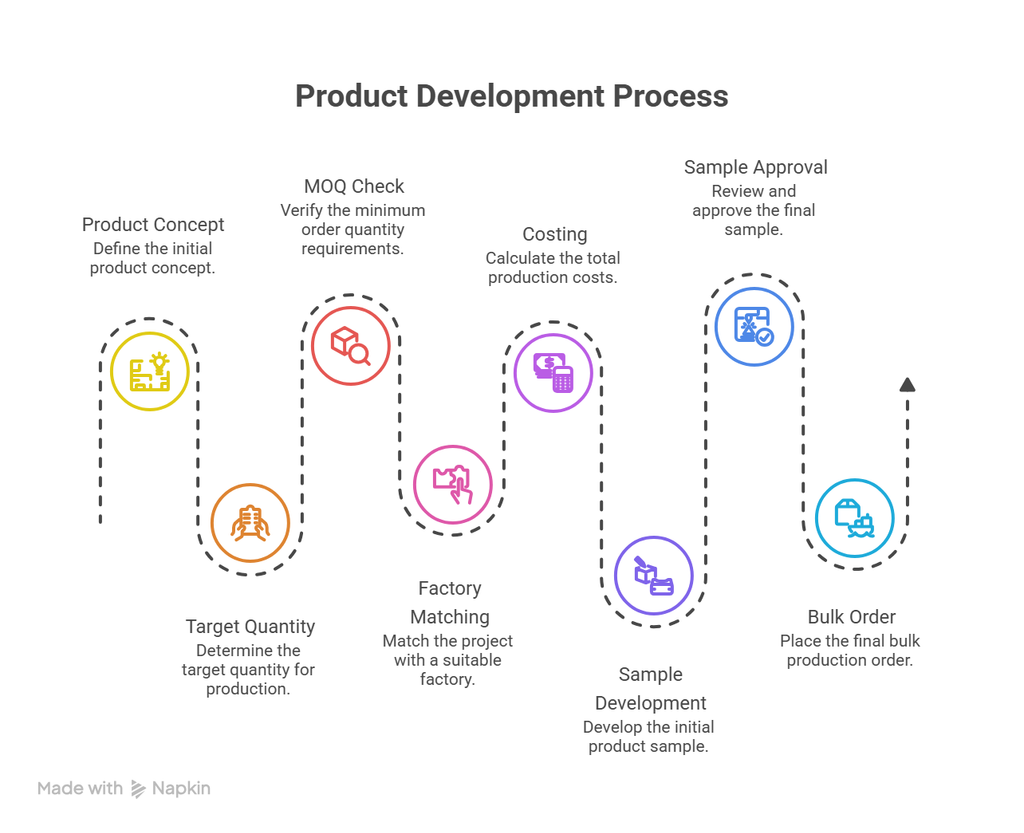
This can save significant time and development costs.
MOQ Is Also a Factory-Selection Tool
MOQ can tell you something about a factory’s business model.
Very high MOQ
May indicate:
- Large-scale production
- High-capacity lines
- Large retail programs
- Strong efficiency at volume
Moderate MOQ
May indicate:
- Mid-sized factory
- Flexible production
- Diverse buyer base
Very low MOQ
May indicate:
- Small production operation
- Sampling-oriented production
- Stock-fabric model
- Higher unit cost
- Special low-volume service
None of these is automatically good or bad.
The important question is:
Does the factory’s operating model match my business?
Protecting Your Margin: The Golden Rule
Never negotiate MOQ in isolation.
Always negotiate:
MOQ + FOB + Quality + Lead Time + Payment + Compliance + Reorder Terms
A lower MOQ that produces an unacceptable margin is not a successful negotiation.
Likewise, a very low FOB price that forces you to purchase excessive inventory may create more financial risk than value.
The objective is to find the best commercial balance.
Why the Right Bangladesh Sourcing Partner Matters
For international buyers without a local team, MOQ negotiation can be especially difficult.
A professional Bangladesh sourcing partner can help bridge the gap between:
Buyer Requirements
and
Factory Economics
The partner’s role should be to understand both sides.
For example:
Buyer wants: 500 pieces
Factory wants: 1,000 pieces
Instead of simply arguing over the difference, the sourcing partner should investigate:
- Can stock fabric be used?
- Can colors be consolidated?
- Can another factory produce 500 pieces?
- Can the order be split?
- Can a trial program be created?
- Can the buyer commit to future production?
- What is the true small-run cost?
That is where experienced local sourcing knowledge can create real value.
How ELITE SOURCING BD Can Help
ELITE SOURCING BD helps international buyers navigate Bangladesh’s apparel manufacturing ecosystem with a focus on practical, transparent and buyer-oriented sourcing.
Our sourcing support can include:
- Factory matching
- MOQ negotiation
- Product development
- Costing
- Sample coordination
- Fabric and trim sourcing
- Production follow-up
- Quality control
- Compliance coordination
- Inspection
- Packaging
- Shipment coordination
For buyers concerned about high MOQs, our objective is not simply to promise an unrealistically low number.
Instead, we focus on finding a commercially realistic production solution that balances:
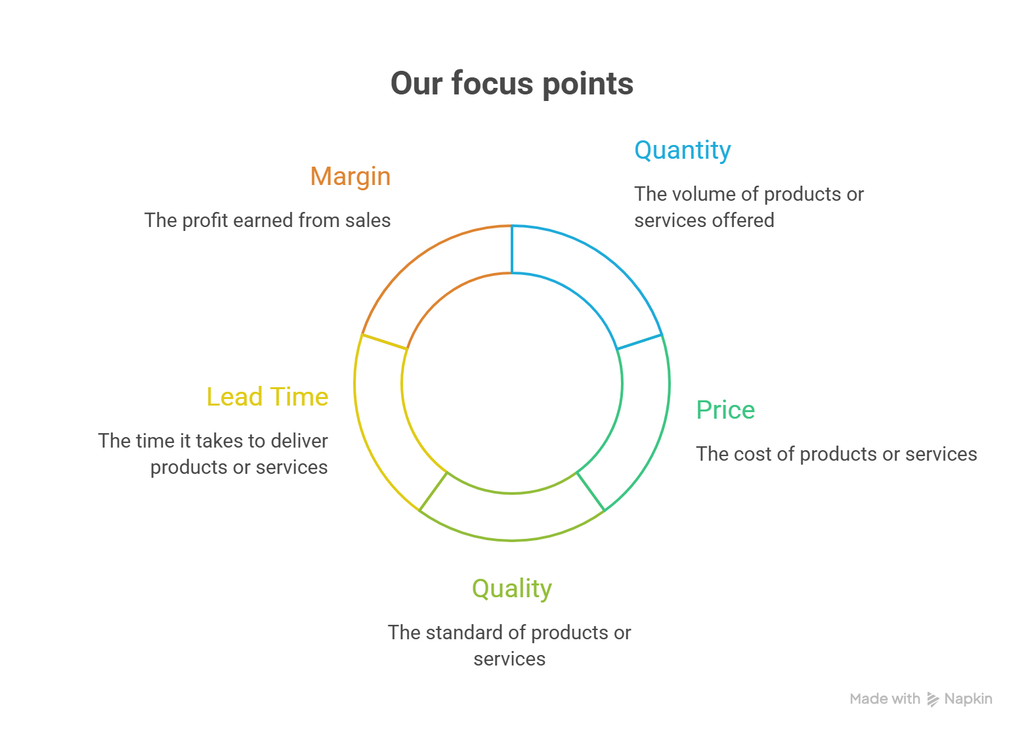
Whether you are launching a new apparel brand, testing a new collection or expanding an established sourcing program, the right factory and the right MOQ strategy can make a significant difference to your profitability.
Final Takeaway
Negotiating MOQ in Bangladesh is not about forcing a factory to accept the smallest possible order.
It is about understanding why the minimum exists and changing the economics where possible.
The strongest buyers:
- Understand their target quantity
- Know their margin
- Ask what drives the MOQ
- Consolidate colors
- Share fabrics across styles
- Use available materials when appropriate
- Simplify unnecessary customization
- Offer credible repeat-order potential
- Compare multiple quantity-price levels
- Select the right-sized factory
- Evaluate total cost rather than FOB alone
Remember:
The goal is not the lowest MOQ. The goal is the most profitable MOQ.
A 500-piece order at a healthy margin may be better than a 5,000-piece order that ties up cash and creates excess inventory.
Likewise, a 1,000-piece order at a competitive FOB may be far better than forcing a factory down to 300 pieces and paying an excessive short-run premium.
The best MOQ is the quantity that allows your supplier to produce efficiently while allowing your business to sell profitably and manage inventory responsibly.
Ready to Source Apparel From Bangladesh?
If you are looking for suitable factories, competitive MOQ options and professional sourcing support in Bangladesh, ELITE SOURCING BD can help you evaluate the right production strategy for your product and target market.
Start Your Sourcing With Us.
Send your tech pack, product specifications, target quantity and delivery requirements to begin.
Frequently Asked Questions
What is the typical MOQ for garments in Bangladesh?
There is no universal MOQ. Depending on product, fabric and factory, buyers may encounter minimums ranging from several hundred pieces to several thousand pieces. Current Bangladesh suppliers publicly advertise examples around 500 pieces for selected categories and 1,000+ pieces for others.
Can I order less than the factory’s stated MOQ?
Sometimes. The factory may accept a smaller order with a higher unit price, use stock fabric, consolidate colors, simplify trims or treat the first order as a trial program. The solution depends on the reason behind the MOQ.
Why is MOQ higher for different colors?
Each color can create separate fabric, dyeing and production requirements. Some factories therefore set MOQ per color rather than per style.
How can I reduce MOQ without increasing the price too much?
Consider consolidating colors, using the same fabric across multiple styles, using suitable stock fabric, simplifying trims and choosing a factory whose production model matches your order size.
Is low MOQ always better?
No. Low MOQ often comes with a higher unit price. A larger order may produce a lower FOB cost, but excessive quantity can create inventory and cash-flow risk.
What MOQ should a new clothing brand target?
There is no universal answer. A new brand should base its initial quantity on realistic sales forecasts, available working capital, target margin and the factory’s economical production quantity. A controlled trial order can be preferable to overbuying inventory.
Can a Bangladesh sourcing agent negotiate MOQ for me?
Yes. A sourcing partner can identify factories with more appropriate production minimums, investigate the underlying MOQ constraints and negotiate alternatives such as consolidated colors, shared fabrics or trial orders.
Should MOQ be calculated per style or per color?
Always ask the factory. Both structures are used. A factory may quote one MOQ per style while another requires the minimum quantity for every individual color.
Can I negotiate MOQ before making a sample?
Yes—and it is often advisable. Confirming MOQ, indicative pricing and production feasibility before investing heavily in development can prevent wasted time and sampling costs.