
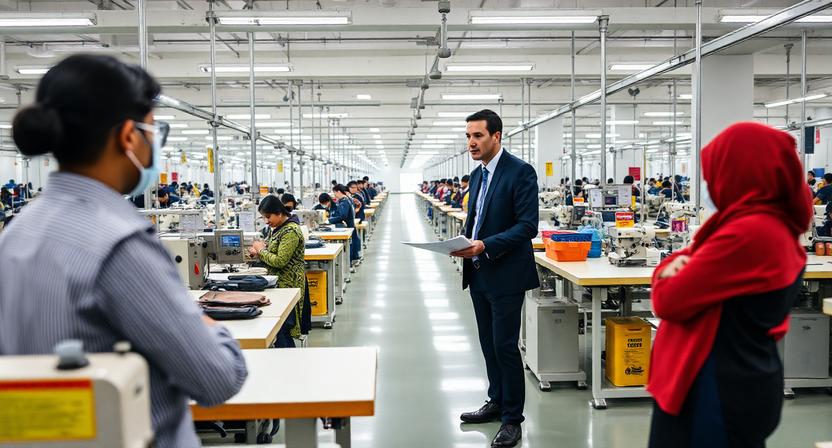
For international apparel buyers, choosing between a sourcing agent and a direct factory relationship is one of the most important decisions in the supply chain.
At first glance, going directly to a garment factory appears to be the obvious choice. You communicate with the manufacturer, negotiate the factory price, and avoid an intermediary. That can create attractive unit economics—especially when order volumes are large and the buyer has an experienced sourcing team.
But there is another side to the equation.
Finding the right factory, verifying compliance, developing samples, negotiating prices, monitoring production, managing quality control, resolving production issues, checking documentation, and coordinating shipment all require time, expertise, and local presence.
That is where a professional apparel sourcing agent or buying house can add significant value.
The right question, therefore, is not simply:
“Which option is cheaper?”
The better question is:
“Which sourcing model gives my business the best combination of cost, quality, control, speed, compliance, and risk management?”
This buyer’s framework explains how to evaluate both options objectively and determine which model is best for your apparel business.
Before comparing the two approaches, it is important to understand what each model actually involves.
Direct Factory Sourcing
With direct sourcing, the buyer works directly with a garment manufacturer.
The buyer is generally responsible for:
The major advantage is direct control over the factory relationship.
However, the buyer also takes responsibility for managing the entire process.
Working With a Sourcing Agent
A professional sourcing agent or buying house acts as the buyer’s local sourcing partner.
Depending on the service model, the partner may manage:
This model gives an overseas buyer a local team that can coordinate the manufacturing process on their behalf.
Modern Bangladesh buying houses commonly position themselves as an extension of the buyer’s sourcing team rather than simply as an intermediary.
One of the biggest mistakes is buyers make is comparing only the quoted FOB price.
For example:
Direct Factory Quote: $5.00 per garment
Sourcing Agent Quote: $5.15 per garment
At first glance, the direct factory appears to be cheaper by $0.15.
But what happens if the buyer must spend additional money on:
The true comparison is therefore:
Total Cost = Product Cost + Sourcing Cost + Quality Cost + Management Cost + Risk Cost
A professional sourcing decision should consider total landed and managed cost, not merely factory price.
A practical way to choose between direct sourcing and an agent is to evaluate both options across ten critical factors.
1. Product Cost
Direct Factory
Direct sourcing can provide excellent pricing because there is no sourcing-agent service fee or margin.
This can become particularly attractive for:
Sourcing Agent
An agent may add a service fee or agreed commission.
However, an experienced sourcing partner can sometimes improve the overall commercial result by:
Winner: Direct factory for experienced high-volume buyers; sourcing agent can be more efficient for smaller or less experienced buyers.
2. Factory Selection
Finding a factory is easy.
Finding the right factory is much harder.
The cheapest factory is not necessarily the best factory.
A buyer should evaluate:
A sourcing partner can help narrow the supplier pool based on these factors.
For example, Bangladesh has different manufacturing clusters and factory capabilities across knitwear, woven garments, sweaters, denim, outerwear and other categories. A sourcing partner’s local network can therefore be valuable when the buyer does not have an established supplier base.
Winner: Sourcing agent for new buyers; direct sourcing for buyers with an established and verified supplier network.
3. Quality Control
Quality control is one of the most important differences between the two models.
With direct sourcing, the buyer must create and manage the inspection system.
That can include:
With a professional sourcing partner, these processes can be coordinated locally.
The important point is that buyers should not simply ask:
“Do you provide QC?”
Instead, ask:
“Exactly how is quality controlled, documented and reported?”
Look for a clearly defined quality system, inspection standards, reporting procedures and corrective-action process.
Winner: Sourcing agent when the buyer does not have an experienced local QA/QC team.
4. Communication
International apparel production involves hundreds of small decisions.
Examples include:
Miscommunication can result in expensive production errors.
A local sourcing partner can act as the communication bridge between the buyer and factory.
However, direct factory communication can be faster and more transparent when the buyer has an experienced merchandising team.
Winner: Depends on the buyer’s internal team.
5. Compliance and Responsible Sourcing
Compliance has become increasingly important for international apparel buyers.
Depending on the destination market and buyer requirements, suppliers may need to demonstrate compliance with relevant:
A sourcing partner can help buyers identify suitable factories and coordinate documentation, audits and corrective actions.
But buyers should never assume that an agent’s statement automatically proves factory compliance.
Always verify the certification and audit status of the specific factory producing your order.
Some Bangladesh sourcing companies publicly describe processes that include checking current social, structural, fire and electrical safety documentation before allocating orders.
Winner: Sourcing agent for buyers without their own compliance team—but verification remains the buyer’s responsibility.
6. Order Volume and MOQ
Order volume can significantly influence the decision.
Direct sourcing may be better when:
An agent may be better when:
A sourcing partner with relationships across multiple factories may have more flexibility in matching smaller or specialized programs with appropriate suppliers.
Winner: Depends on order volume and factory requirements.
7. Speed to Market
Speed is increasingly important in fashion.
A buyer may need to move from:
Tech Pack → Costing → Sample → Approval → Production → QC → Shipment
as quickly as possible.
Going direct can be very efficient when the buyer already has a strong factory relationship.
For a new buyer, however, establishing the relationship, checking the factory, negotiating terms and coordinating development can take considerably more management time.
A sourcing agent can potentially shorten the supplier-discovery stage because the buyer is accessing an existing local network.
Winner: Sourcing agent for new supplier discovery; direct factory for established relationships.
8. Transparency
Transparency is critical.
A good sourcing partner should clearly explain:
The buyer should know whether the sourcing partner is charging:
Avoid relationships where the commercial structure is deliberately unclear.
Transparency should be a selection criterion—not an afterthought.
9. Risk Management
This is where the comparison becomes more interesting.
Direct sourcing provides greater control, but it also places more responsibility on the buyer.
Potential risks include:
A professional sourcing partner can reduce some of these operational risks by providing local oversight.
However, an agent also introduces its own risks.
Therefore, buyers should perform due diligence on the sourcing agent itself.
Ask:
Winner: Sourcing agent when the buyer lacks local infrastructure; direct when the buyer has strong internal controls.
10. Long-Term Scalability
For a growing apparel brand, today’s sourcing model may not be the ideal model five years from now.
A common progression can look like:
Stage 1: New buyer → Sourcing partner
Stage 2: Growing buyer → Hybrid sourcing
Stage 3: Established buyer → Direct strategic factories
This does not mean an agent must eventually disappear.
Many mature brands continue using sourcing partners because they value:
The best model evolves with the business.
| Factor | Sourcing Agent | Direct Factory |
| Factory price | May include service fee | Potentially lower |
| Factory selection | Managed by sourcing partner | Buyer manages |
| Local presence | Usually available | Buyer needs own team |
| Quality control | Can be managed locally | Buyer arranges |
| Compliance support | Often available | Buyer responsible |
| Communication | One managed contact | Direct with factory |
| Factory transparency | Depends on agent | Direct |
| Supplier flexibility | Usually higher | Limited to chosen factory |
| Management workload | Lower | Higher |
| Buyer control | High with good reporting | Maximum |
| Best for new buyers | Excellent | More challenging |
| Best for high-volume buyers | Depends | Often excellent |
| Best for remote buyers | Excellent | More difficult |
| Scalability | High | High with infrastructure |
Buyers do not necessarily have to choose only one model.
A hybrid sourcing strategy can combine the advantages of both.
For example:
Phase 1 — Use a Sourcing Partner
Use a sourcing agent to:
Phase 2 — Build the Relationship
Once a factory proves reliable:
Phase 3 — Increase Direct Control
As order volume grows, the buyer can introduce:
This approach can allow a brand to start with lower operational risk and gradually build its own sourcing infrastructure.
A sourcing agent or buying house may be the better choice if:
You are new to Bangladesh sourcing
If you have never sourced from Bangladesh before, local expertise can save significant time.
You do not have a Bangladesh office
Managing production remotely can be challenging.
Your order quantities are relatively small
An experienced sourcing partner may help identify factories that fit your volume requirements.
You need multiple product categories
A sourcing partner can coordinate different factories for different products.
You need strong production follow-up
A local team can monitor production more frequently than an overseas buyer.
You need quality assurance
A professional QA/QC structure can provide additional control.
You prioritize time
If your internal team wants to focus on design, sales and marketing rather than production administration, outsourcing sourcing management can make sense.
Direct factory sourcing may be the better choice if:
You have large recurring orders
High-volume buyers can often negotiate very competitive factory pricing.
You have an experienced sourcing team
If you already have experienced merchandisers, QA professionals and compliance specialists, an agent may not be necessary.
You have a trusted factory relationship
If the factory consistently delivers quality, pricing and delivery performance, maintaining a direct relationship can be highly efficient.
You have a local office or representative
Local infrastructure dramatically changes the economics of direct sourcing.
You want maximum factory-level control
Direct communication can provide immediate visibility into production decisions.
Before signing an agreement, ask these questions:
The quality of the answers can tell you more than a polished company presentation.
Whether you choose an agent or direct factory, watch for these warning signs.
🚩 Unusually Low Prices
If a quotation is dramatically lower than competing offers, investigate why.
🚩 No Factory Disclosure
A legitimate buyer should understand who is producing their goods.
🚩 Unclear Commission
Avoid hidden margins and unexplained charges.
🚩 No Compliance Documentation
Do not rely solely on verbal claims.
🚩 Refusal to Allow Factory Visits
Transparency should be part of the relationship.
🚩 Poor Communication
Slow or inconsistent communication before an order is often a warning sign for what happens after the deposit.
🚩 Pressure to Pay Quickly
Professional sourcing relationships should allow reasonable due diligence.
🚩 No Written Specifications
Product requirements should be documented through tech packs, approved samples and written purchase terms.
You can score each factor from 1 to 5.
| Factor | Weight | Agent | Direct |
| Lowest possible unit cost | 15% | ||
| Local market knowledge | 15% | ||
| Quality control | 15% | ||
| Compliance management | 10% | ||
| Communication | 10% | ||
| Supplier flexibility | 10% | ||
| Buyer control | 10% | ||
| Time savings | 10% | ||
| Scalability | 5% |
Multiply your score by the weight.
The highest overall score gives you a more objective decision than simply choosing whichever quotation has the lowest price.
Ultimately, the sourcing-agent-versus-direct-factory decision comes down to one question:
Who is responsible for making sure the order succeeds?
If you go direct, you are.
You must manage:
Factory → Sampling → Production → Quality → Compliance → Documentation → Shipment
If you work with a sourcing partner, some of those responsibilities can be delegated.
But delegation only works when the partner is professional, transparent and accountable.
That is why the goal should not be to find the cheapest intermediary.
The goal should be to find the right operating partner.
There is no universal winner.
Choose a sourcing agent when you value:
Choose direct factory sourcing when you have:
Consider a hybrid model when:
You are growing and want to gradually move from outsourced sourcing management toward direct strategic supplier relationships.
The best sourcing strategy is ultimately the one that aligns with your order volume, product complexity, experience, risk tolerance, budget, compliance requirements and long-term growth strategy.
Bangladesh remains a major apparel manufacturing and export base, giving international buyers access to a deep ecosystem of garment manufacturers and specialized suppliers.
But sourcing successfully from Bangladesh is about more than finding a factory with a competitive FOB price.
Successful sourcing requires coordination across:
Product Development → Costing → Factory Selection → Sampling → Materials → Production → Quality Control → Compliance → Documentation → Shipment
A capable local sourcing partner can help international buyers navigate this ecosystem while maintaining communication and operational visibility.
For buyers without an established Bangladesh sourcing team, this can be particularly valuable.
ELITE SOURCING BD is positioned as a Bangladesh-based apparel sourcing and buying partner for international buyers seeking reliable garment sourcing solutions.
Our approach is designed around the buyer’s requirements rather than simply finding the cheapest factory.
We can support buyers with:
Our objective is simple:
Make apparel sourcing from Bangladesh more transparent, efficient and reliable for international buyers.
Whether you are launching your first apparel collection or expanding an established sourcing program, the right manufacturing strategy can have a significant impact on your margins, quality and customer satisfaction.
You do not necessarily need to choose between “agent” and “factory” based only on price.
Start by evaluating:
Your Volume + Your Experience + Your Team + Your Risk + Your Compliance Requirements + Your Growth Plans
Then choose the model that gives your business the strongest overall result.
If you are considering sourcing garments from Bangladesh, ELITE SOURCING BD can help you evaluate suitable sourcing options and connect your requirements with appropriate manufacturing capabilities.
Start Your Sourcing With Us
Send us your product requirements, tech pack, target quantity and delivery requirements to begin your Bangladesh apparel sourcing journey.
Is it cheaper to use a sourcing agent or buy directly from a factory?
Direct factory sourcing can offer a lower unit price because there is no sourcing-agent service fee. However, the buyer must also account for quality control, factory verification, production management, travel, inspections and other operational costs. The cheapest factory quote is not always the lowest total sourcing cost.
What does an apparel sourcing agent do?
An apparel sourcing agent can help international buyers identify suitable factories, negotiate pricing, coordinate samples, monitor production, manage quality control, support compliance and coordinate documentation and shipment.
Is direct factory sourcing better for large orders?
It can be. Large and recurring orders may justify direct factory relationships, particularly when the buyer has experienced sourcing and quality teams. However, some large buyers continue using sourcing partners for local expertise and supplier management.
Is a sourcing agent necessary for sourcing from Bangladesh?
No. Buyers with strong local teams and established factory relationships can source directly. A sourcing agent becomes particularly valuable for buyers who are new to Bangladesh, operate remotely or lack local production and quality-control infrastructure.
How do I verify a Bangladesh sourcing agent?
Check the company’s business identity, experience, sourcing process, factory network, fee structure, references, quality-control procedures and transparency regarding manufacturing facilities. Ask for documentation supporting any compliance claims.
Can I switch from a sourcing agent to direct factory sourcing?
Yes. Some buyers initially use a sourcing partner to identify and qualify factories and later develop direct relationships with proven manufacturers. Others continue using a sourcing partner because the local management and quality-control services remain valuable.
What is the difference between a sourcing agent and a buying house?
The terminology varies by market. A sourcing agent may focus primarily on finding suppliers and negotiating orders, while a full-service buying house may provide broader services such as merchandising, product development, production follow-up, quality control, compliance coordination and shipment management.
Conclusion
The choice between working with a sourcing agent vs. going direct should never be reduced to a simple comparison of factory prices.
Direct sourcing can provide excellent control and attractive pricing for experienced, high-volume buyers.
A professional sourcing agent can provide local expertise, supplier access, production oversight, quality control and risk management for buyers who do not have their own infrastructure.
The smartest buyers look beyond the quotation.
They evaluate the total cost, total workload, total risk and total value of each sourcing model.
For many international apparel brands—particularly those entering Bangladesh for the first time—the right local sourcing partner can turn a complex supply chain into a much more manageable process.
The best sourcing strategy isn’t necessarily the one with the lowest quoted price. It’s the one that delivers the right product, at the right quality, at the right cost, at the right time—with the right level of control.