
Apparel Manufacturing Technologies: CAD, Robotics, IoT & AI
CAD/CAM (Computer-Aided Design and Manufacturing)
Description: CAD/CAM systems integrate digital design tools with manufacturing machines. In apparel, CAD is used for pattern making, grading and marker planning, while CAM drives automated cutters. CAD allows faster design iterations and prototyping without physical samples. By linking design and production, manufacturers can “move seamlessly” from a digital pattern to automated cutting. For example, CAD software lets teams check fit in 3D before production, reducing costly errors. In practice, designers create a 3D model or flat sketches which are exported to pattern-making software (e.g. Lectra or Gerber). CAM then translates the pattern into cutting commands.
Benefits: Faster product development (skip physical prototypes); precise pattern accuracy and fit; automated marker making for efficient fabric usage (our Garment Production Workflow guide notes CAD markers minimize waste); reduced labor and errors in pattern drafting and cutting. CAD streamlines collaboration: modern tools even enable cross-platform pattern exchange (e.g. Lectra/Gerber integration). Overall, CAD/CAM can cut development time by up to 50% while ensuring one-time “machining success”.
Challenges: High initial investment in software, hardware and training. Smaller factories may lack skilled CAD operators. Interoperability between systems has been a historic issue (pattern converters are needed when different factories use different CAD systems). There is also a learning curve to adopt digital tools. Legacy factories often need process redesign to fully exploit CAD/CAM.
Case Study/Example: Large brands like Nike, Adidas and H&M use CAD/CAM extensively for pattern and prototype design. Many tier-1 factories in Asia have Lectra Modaris or Gerber AccuMark systems. For instance, a multi-line knitwear plant might use CAD to automate marker making and connect directly to automated cutting tables, slashing marker generation from hours to minutes.
Impact on Cost/Quality/Speed/Sustainability: CAD/CAM requires high capex but lowers per-unit labor costs. It improves quality (digital accuracy, fewer fit errors) and drastically speeds up design cycles. By optimizing marker layouts and enabling digital pattern libraries, CAD/CAM also improves sustainability (less material waste and fewer sample garments). The return on investment often comes from faster time-to-market and reduced rework.
Automated Fabric Cutting
Description: Automated cutting machines (CNC cutters, lasers or waterjets) cut fabric layers according to CAD patterns. Unlike manual cutting, these machines can slice through dozens of fabric plies accurately. In high-volume factories, an automated cutter picks up a marker layout from CAD and cuts out panels for hundreds of garments with precision. This complements CAD by executing the cut phase without human error.
Benefits: Greatly increased speed and consistency. Automated cutters work continuously (24/7 if needed) and handle large volumes quickly. Accuracy is higher than manual cutting, reducing pattern distortions. Fabric utilisation is maximised: computer-planned markers and precise cutting minimize scrap. Labor is freed from the tedious spreading/cutting tasks. Many cutters also include automatic stacking and bundling, further cutting cycle time.
Challenges: High equipment cost (often hundreds of thousands of dollars for an industrial cutter). Need stable, flat cutting tables and skilled technicians to operate/maintain the machines. Sharp knives and lasers require regular maintenance. Not all garment styles suit rigid panel cutting (very stretchy or oddly shaped pieces may still need hand finishing). Space is also a factor, as cutting rooms must accommodate the machinery.
Case Study: Companies like Eastman Machine Company, Lectra, Zünd and Gerber lead in cutting systems. For example, a denim factory might install a Zünd cutter to handle indigo-dyed denim marker layouts, cutting 30 layers of fabric in one go. The machine’s precision reduces size and color mismatches. Smaller makers may use laser cutters for pattern prototyping.
Impact: Automated cutting cuts labor costs and speeds up production (markers to cut in minutes rather than hours). Quality improves because each panel is cut precisely, reducing downstream sewing errors. Cost savings on material waste are significant – even a 1% marker improvement saves large amounts on big orders. Sustainability improves as waste fabrics decline. ROI timeframe varies (1–3 years typical), depending on utilization; higher volume lines see quicker payback.
Digital Textile Printing
Description: Digital printing applies ink directly to fabric from a computer file, much like an inkjet printer for paper. In apparel, this allows complex, photo-quality prints on demand without screens. The workflow is fast: designers send a digital artwork to the printer, which lays ink on pre-treated fabric. Digital textile printers use dye, pigment or sublimation inks on cotton, polyester, blends or synthetics. Recent advances integrate AI and automation to monitor print quality (e.g. vision cameras detect clogged nozzles).
Benefits: Ultimate flexibility and design freedom – virtually no limits on color count or pattern complexity. Great for short runs, sampling, on-demand and customization (for example, a fashion brand can test prints without committing to bulk screens). Lead time is much shorter, as no screen setup is needed. Crucially, digital printing drastically reduces water and energy use: it consumes far less water than traditional rotary printing and avoids wasted offcuts of fabric. Inks can be low-impact (some are eco-certified). Fast color changes improve agility in reacting to trends.
Challenges: Slower throughput for very large volumes – screen printing can still be faster and cheaper at high volume. Fabric needs uniform pre-treatment, otherwise color may not fix properly. Print heads and inks are expensive, and maintenance is critical. Color accuracy and repeatability can be challenging across multiple runs or fabrics. Some digital inks (especially sublimation dyes) require special polyester fabrics. Printers also have high initial cost (tens to hundreds of thousands USD).
Case Study: Brands like Nike and Vans have used digital printing for limited-edition lines. Equipment makers like Kornit, Mimaki and EFI offer apparel-grade printers. A notable example: sportswear companies now use pigment digital printing to avoid steaming/washing steps (pigment printing “eliminates the need for steaming and washing, saving water and energy”). Digital printing is also expanding into home textiles and fast fashion.
Impact: Cost is moderate to high (capex + ink costs), but saves money on setups (no screens/dyes per design). Quality is high (sharp prints) but requires QC to ensure colorfastness. Production speed for small batches is fast; for huge runs, digital may lag traditional methods. Sustainability impact is strongly positive: digital printing can reduce water use by an order of magnitude compared to dye vats. ROI depends on run lengths: best for medium/low runs and high-mix, where waste and inventory costs outweigh higher ink price.
3D (Wholegarment) Knitting
Description: 3D knitting machines (also called wholegarment machines) knit an entire garment in one piece without seams. They use computerized flat knitting technology (often four- or six-needle-beds) guided by a 3D digital model (essentially CAD for knitting). The machine can knit arms, body and collar all in one cycle, as the software commands which needles knit each section. The result is a finished sweater (or hosiery, or shoe upper) coming off the machine fully formed.
Benefits: Minimal waste – with no cut-and-sew, nearly 99% of the yarn ends up in the garment. This yields lighter products (about 10% lighter than cut-sewn of the same size) and no seam weakness. Seamless fit and comfort are better (no seams to chafe). Production is more flexible – you can knit exactly to size, reducing post-sewing adjustments. Inventory can be just-in-time because you knit per order, supporting mass customization. Complex 3D structures or jacquards can be integrated in a single pass. On sustainability, 3D knit garments are easier to recycle whole, and the process avoids cutting scraps.
Challenges: Extremely high machine cost – multi-bed machines run tens of thousands of euros. The market is also still niche, so volumes are low. Only knitwear garments (sweaters, hosiery, some upper footwear) are suited; woven and many apparel types still require traditional methods. Programming and designing for wholegarment knit is more complex. Changes after knitting are limited (you can’t easily alter a finished knit). Yarn costs tend to be higher-quality for performance. Factories adopting 3D knit machines need to also manage a different workflow (less sewing, more yarn handling).
Case Study: Boutique brands (like OLIVER CHARLES) use 3D knitting in Brooklyn to knit custom sweaters on-demand. Major sportswear firms (e.g. Adidas with Primeknit, Nike Flyknit) use a version of 3D knit for shoe uppers. Shima Seiki and Stoll (Groz-Beckert) lead machine makers – Shima’s WholeGarment line can make hats, gloves, T-shirts, socks, even jeans 3D. Japan’s Shima Seiki introduced compact wholegarment machines (SWG-N2 series) to allow multi-color knitting with faster cycle times.
Impact: Very high upfront cost; ROI is long-term and depends on premium pricing or sustainability goals. Quality is excellent (fewer seams, durable knit structure) and speed per unit is high for complex knits. Production time per unit can be shorter since multiple steps merge (knit+seam). Sustainability impact is strong: waste is near-zero by design, and a seamless garment typically lasts longer and uses less material. Suitable factory scale: often boutique or specialized lines, though large brands are experimenting.
Sewing Automation and Robotics
Description: Sewing robots (often called “sewbots”) automate stitching tasks. Modern systems combine robotic arms with sewing heads and computer vision. Unlike a human-guided machine, a sewbot feeds fabric via clamps and vision cues, stitching automatically. Examples include robotic arms that can hem a T-shirt or sew a complex curved seam without human intervention. These systems are rapidly improving; in 2026 sewing robots can stitch like humans, freeing operators from repetitive tasks.
Benefits: Massive labor savings on repetitive, standard operations. Robots can sew shirts, jeans, basics at high speed (thousands of units per shift). Precision is consistent: robotic vision and control maintain uniform stitch quality, reducing defects and line rework. They run non-stop and don’t tire, so throughput rises and lines can operate longer. Automated tension and trimming cut cycle time. By handling tasks like hemming or sleeve attachment, robots let skilled workers focus on quality checks and customization. In summary, robots improve consistency (“uniform sizing, stitch accuracy, and quality across large batches”) and shorten lead times.
Challenges: Soft, stretchy or very delicate fabrics remain hard for robots to feed and control. Complex stitching (multi-layer, zigzags, decorative patterns) still may need human skill. Feeding fabric smoothly is critical – errors in fabric handling can ruin the cycle. Upfront cost is high (hundreds of thousands for a full cell) and ROI depends on volume. Factories must train operators and perhaps re-layout assembly lines to integrate robots. Some systems require stiffening (like Sewbo’s paste stiffened fabric) or specialized feeders. Safety (collision avoidance) and programming (though modern robots use no-code interfaces) are additional considerations.
Case Study: Standard Bots (US) and SoftWear Automation (Georgia, USA) offer commercial sewbots. For instance, SoftWear’s Sewbot has been tested sewing T-shirts and jeans seams at brand factories. One large apparel manufacturer reported robotic sew cells maintaining exact stitch uniformity on 100% cotton tees, cutting error rates dramatically. In 2026, automated sewing is expanding: it is “especially effective for high-volume basics where consistency and speed are critical”. Industry briefs show fully automated cells can operate lights-out, while small retrofit cobots are used for niche tasks.
Impact: Initial investment is steep but labor cost reductions can pay off in 2–5 years for high-volume lines. Quality improves through consistency (robots eliminate human variability). Sewing speed (cycle time per garment) increases – e.g. a robot can hem a T-shirt in seconds. Sustainability gains are indirect (faster production means less idle equipment time and fewer rejects reduce waste). Factory sizes best suited are medium-to-large where volumes justify automation. Smaller shops may start with a single cobot for specialized tasks.
IoT and Smart Factories
Description: Internet of Things (IoT) connects machines, sensors and software to digitize the factory. In a “smart” apparel factory, sewing machines, cutting tables and even garments on the line have sensors sending data in real time. Dashboards can show machine status, line efficiency, and quality metrics instantly. For example, an IoT system might notify supervisors if a feeder motor slows or if defect rates spike. This visibility allows rapid response: managers can redistribute work if one line stalls or schedule maintenance before breakdowns.
Benefits: Enhanced efficiency and uptime. IoT-enabled predictive maintenance minimizes unexpected stops (sensors alert when machines deviate from norms). Real-time monitoring reduces bottlenecks and idle time. Quality control is boosted – cameras/sensors detect fabric defects or stitching errors on the fly, catching issues earlier. Supply chain visibility improves as well: IoT tagging (RFID, BLE beacons) lets factories track inventory from raw fabric to finished goods, aiding planning. In summary, factories can run leaner with better on-time delivery and yield.
Challenges: Upfront costs include sensors, network infrastructure and software. Factories must secure data networks (cybersecurity risk). Integrating IoT often requires retrofitting old equipment with sensors. Staff need training in new tools and data literacy. Standardization is a hurdle – connecting legacy machines and ensuring they “speak” a common protocol can be complex. Return on IoT can take years to realize, as workflows are adjusted.
Case Study: Shanghai Fumao Garment (a Chinese manufacturer) reports that integrating IoT led to real-time tracking of machine performance and automated maintenance alerts, reducing idle time. They use RFID tags on shipments to give clients live updates. Globally, textile firms like H&M group and GAP have piloted IoT systems in Cambodia and China to monitor sewing lines, achieving roughly 10–20% gains in labor productivity.
Impact: IoT is a mid-range investment that pays off via operational savings. It can lower production costs (through fewer breakdowns and better yield) and improve quality consistency by flagging defects immediately. Cycle times shorten as problems are resolved on the fly. Sustainability benefits come from reduced waste (fewer rejected garments) and optimized energy use (smart HVAC and lighting). IoT applies to all factory sizes, but it scales especially well in large, multi-line factories.
AI for Quality Control & Demand Forecasting
Description: Artificial Intelligence (AI) and Machine Learning (ML) are applied in apparel for both visual inspection and demand planning. In quality control, computer vision systems scan fabric and garments, using ML to recognize and classify defects (holes, stains, color shifts). For demand forecasting, AI algorithms analyze sales data, trends and external factors to predict future orders more accurately than traditional methods. These uses harness the vast data now available in modern supply chains.
Benefits: For quality, AI dramatically improves defect detection rates. For example, Shelton Vision’s AI-based WebSpector can inspect woven or knit rolls at over 100 meters/minute, detecting “over 98% of faults” – far above manual inspection levels. This not only prevents defective garments reaching customers but also optimizes fabric usage by identifying flaws early. For forecasting, AI excels at processing large, complex datasets (seasonality, market trends, promotions) to produce more reliable demand plans. Case studies in manufacturing show AI forecasting can reduce overstock and stockouts by 20–50%, aligning production with actual demand.
Challenges: AI systems require high-quality data and considerable tuning. For QC, varied fabric patterns and stretchy materials can confuse vision systems (some updates are needed for new styles). For forecasting, models can be opaque (“black box”) and need regular retraining; they also depend on good historical data (which some brands lack). Implementing AI means hiring data scientists or partnering with vendors, and integrating new software with ERP/PLM systems. There is also a cultural shift: managers must trust AI recommendations, which takes time.
Case Study: Beyond Shelton’s fabric-inspection, large brands use AI in forecasting. A QAD industry survey notes that AI-driven demand planning provides “unmatched precision and adaptability” over traditional forecasting. For example, a global athletic wear firm saw forecast error drop by 30% after deploying an AI tool, enabling leaner inventory. Coats Group (an apparel services company) recently introduced GSD RealMotion, an AI solution analyzing video and data to optimize sewing processes.
Impact: AI systems typically have high development/implementation costs but ROI can be substantial. Accurate forecasting reduces wasted production (cutting labor and raw material costs) and improves customer service. Automated QC lowers labor (fewer inspectors needed) and significantly cuts defects (raising yield and quality). Speed to insight is faster – issues are caught in real time or demand spikes predicted instantly. On sustainability, AI helps reduce waste by avoiding overproduction and scrapped goods. Overall, AI adoption is growing but still maturing; benefits are clearest in large, data-rich companies.
Sustainable Technologies: Waterless Dyeing & Recycling
Waterless Dyeing: Traditional dyeing uses huge volumes of water. Waterless dyeing technologies (like CO₂-dyeing and advanced pigments) drastically cut water and chemical use. For example, dyeing in supercritical CO₂ uses virtually no water, as the dye binds in a closed loop. Similarly, pigment printing or aerosol dyeing processes eliminate wastewater discharge. The apparel industry is piloting these methods: Levi’s “Water<Less®” technique uses ozone and minimal water and brands like H&M and Nike are partnering on water-saving dye projects. Benefits include a 90–100% reduction in water use for dyeing, and lower energy use (no boilers) – aligning with broader sustainability goals. Challenges include high capital costs and the need for specific fabric types (CO₂ systems mainly work on polyester). Impact: Dramatic sustainability gains (often 100% water savings at dye stage), though cost per garment may initially rise.
Textile Recycling: Mechanical and chemical recycling technologies are turning waste textiles and bottles into new yarns. Companies like Unifi (Repreve) transform plastic bottles into polyester fibers used in apparel; advanced outfits can chemically recycle cotton/poly blends back into new fiber. Brands (Patagonia’s recycled wool, H&M’s garment-to-garment fiber recycling) showcase these innovations. Benefits: reduces reliance on virgin materials, cuts landfill waste and CO₂ emissions over the life cycle. Challenges: mixed-material textiles (cotton/poly blends) remain hard to fully recycle without quality loss. Infrastructure is still scaling and recycled yarns can be pricier or lower-performance than virgin. Impact: Medium–long ROI (since customers now value sustainability), positive quality (depends on process) and very high sustainability as recycled fiber greatly lowers footprint.
Supply Chain Traceability (Blockchain & RFID)
RFID Tracking: Radio-frequency Identification tags are increasingly used to track items through production and retail. Factories affix RFID chips on garments or cartons, which are scanned automatically at checkpoints. This enables live inventory tracking – for instance, Inditex (Zara) found that RFID allowed one store team of 10 to count inventory in half the time previously required by 40 staff scanning barcodes. Benefits include real-time inventory accuracy, reduced shrinkage and faster order replenishment. Challenges: tag costs (though prices have dropped), and the need to install RFID readers in factories/warehouses. Impact on cost: moderate (improves supply chain efficiency), on quality: indirect (fewer stockouts and lost items), on speed: major (inventory counts go from hours to minutes). Sustainability: RFID itself is neutral, but enables leaner inventory (reducing waste from overproduction).
Blockchain & Digital Passports: Blockchain is being explored for immutable product histories. A blockchain-based traceability platform records each step (e.g. fiber origin, processing dates) in an unalterable ledger. Proponents claim it will revolutionize transparency and anti-counterfeiting: for example, Provenance has pilots tracing cotton from farm to shirt. The EU’s upcoming Digital Product Passport initiative essentially requires similar traceability data for sustainability compliance. The benefits would be verified sourcing claims and consumer trust. However, blockchain adoption is still in pilots – it requires all parties (mills, factories, brands) to share data. Costs include software development and data integration. Current impact: mostly theoretical, improving brand reputation if implemented. Real-world maturity is low to medium, with most big brands still evaluating projects.
Technology Comparison
| Technology | Approx. Cost Level | Maturity (Industry Penetration) | ROI Timeframe | Sustainability Impact | Factory Size Suitability |
|---|---|---|---|---|---|
| CAD/CAM Systems | High (software, hardware) | High (standard in large apparel firms) | Short–mid (months to 1–2 yr) | Moderate (less prototype waste) | Medium–large (broad use) |
| Automated Cutting | High (equipment) | High (common in cut-and-sew lines) | Mid (1–3 yr) | Moderate (less scrap) | Large (high-volume) |
| Digital Printing | High (printers & inks) | Growing (niche vs traditional) | Mid (1–3 yr) | High (much less water) | Small–medium (short runs/specialty) |
| 3D Knitting | Very High (machines) | Low–Emerging (niche) | Long (3–5 yr) | Very High (near-zero waste) | Small–medium (knitwear lines) |
| Sewing Robotics | Very High (cells) | Low–Emerging (pilots, few lines) | Long (3–5 yr) | Low–moderate (consistent sewing) | Large (high-volume basics) |
| IoT/Smart Factory | Medium (sensors, IT) | Medium (adoption rising) | Mid (2–4 yr) | Moderate (via efficiency) | All (scales to large best) |
| AI (Forecast/QC) | Medium–High (software) | Low–Medium (pilot to early stage) | Mid–Long (2–5 yr) | High (less waste) | Large (data-driven firms) |
| Waterless Dyeing | High (new dyeing units) | Low (few installations) | Long (3–7 yr) | Very High (0–10% water use) | Large (dedicated dye plants) |
| Recycling (fiber) | Medium–High (varies) | Low–Medium (growing) | Long (5+ yr) | Very High (reduces virgin) | Large (specialized facilities) |
| RFID Tagging | Low–Medium (per item cost) | High (many retailers use) | Short (months) | Neutral (enables lean) | All sizes (not in manufacturing only) |
| Blockchain | High (tech development) | Low (pilot phase) | Long (5+ yr) | Moderate (certified sourcing) | All (future initiative) |
Technology Adoption Timeline (approximate)
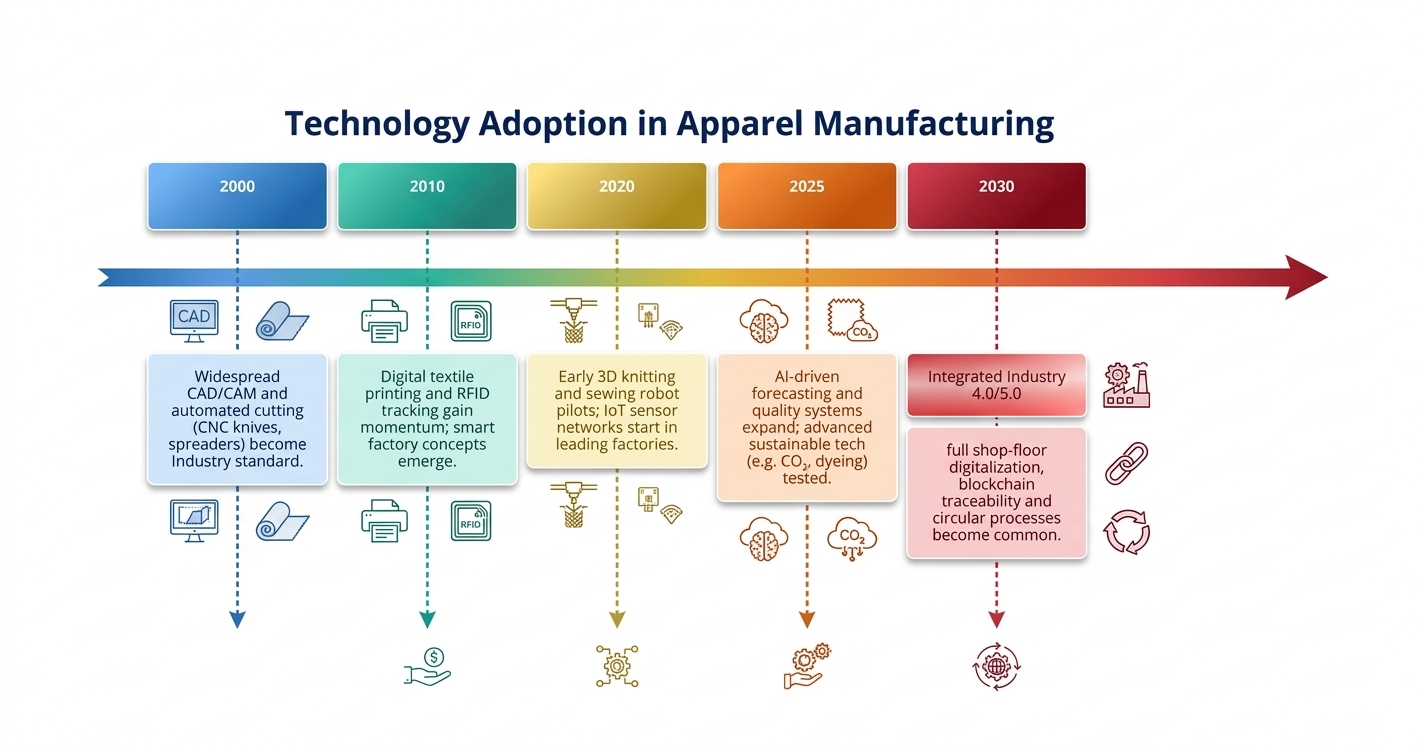
The Future of Apparel Manufacturing and Processing
Technology is transforming the apparel industry by making garment manufacturing faster, more precise, efficient, and sustainable. From AI-powered design and automated cutting to smart sewing systems, digital quality control, and advanced textile processing, modern technologies are helping manufacturers improve product quality, reduce production waste and respond more effectively to changing market demands.
For apparel manufacturers and global buyers, adopting the right technologies is no longer just a competitive advantage—it is an important step toward building a resilient, transparent and future-ready supply chain. However, successful implementation depends on more than machinery alone. Workforce training, production planning, quality management, responsible chemical use and continuous process improvement are equally essential.
In Bangladesh, where the ready-made garment (RMG) industry plays a vital role in the global fashion supply chain, technology adoption offers significant opportunities to enhance productivity, strengthen compliance, improve resource efficiency and meet international buyers’ evolving expectations. By combining skilled professionals with innovative manufacturing and processing solutions, the industry can continue to deliver quality apparel while moving toward more responsible production practices.
Ultimately, the future of apparel manufacturing belongs to businesses that combine technological innovation with operational excellence, sustainability and customer-focused sourcing.
Partner with Elite Sourcing BD
Looking for a reliable apparel sourcing partner in Bangladesh? Elite Sourcing BD can help you explore garment manufacturing solutions, connect with suitable suppliers and manage your sourcing requirements with a focus on quality, efficiency, and buyer expectations.
Whether you are developing a new clothing line, sourcing bulk apparel or looking for dependable manufacturing partners, choosing the right sourcing team can make your supply chain more efficient and responsive.
Ready to take the next step? Visit elitesourcingbd.com to learn more about our apparel sourcing services and discuss your next garment project.
Frequently Asked Questions (FAQs)
1. What are the latest technologies used in apparel manufacturing?
Modern apparel manufacturing uses technologies such as AI-assisted design, 3D garment visualization, automated fabric spreading and cutting, computer-aided design (CAD), computer-aided manufacturing (CAM), digital production monitoring, automated sewing equipment, and AI-supported quality inspection. The technologies used depend on garment type, order volume, budget, and production requirements.
2. How does technology improve apparel manufacturing efficiency?
Technology improves efficiency by reducing manual errors, optimizing fabric usage, shortening product development cycles, improving production planning, and identifying quality issues earlier. Digital production monitoring can also help manufacturers detect bottlenecks and make better use of labor, equipment, and materials.
3. What is the role of AI in the garment manufacturing industry?
Artificial intelligence can support demand forecasting, production planning, fabric defect detection, quality inspection, inventory management, and predictive maintenance. AI tools can help teams make faster, data-informed decisions, although their effectiveness depends on reliable data, suitable systems, and human oversight.
4. How does automation affect garment production?
Automation can improve repeatability, precision, and production speed in suitable operations, including fabric spreading, cutting, material handling, and selected sewing processes. However, garments with complex construction or frequent style changes may still require substantial skilled manual work. Manufacturers should evaluate automation based on product complexity, production volume, investment costs, and expected return.
5. What technologies are used in textile processing?
Textile processing technologies include automated dyeing systems, digital textile printing, advanced washing and finishing equipment, computer-controlled process monitoring, water-treatment systems, and technologies that improve chemical and energy management. These solutions can help improve color consistency, process control, and resource efficiency when properly implemented.
6. How can technology make apparel manufacturing more sustainable?
Technology can support sustainability through optimized fabric cutting, low-liquor-ratio dyeing, digital printing, water and energy monitoring, wastewater treatment, chemical management, and improved production planning. These technologies can reduce material losses and resource consumption, but actual environmental benefits depend on operating conditions, energy sources, chemical inputs, and wastewater controls.
7. Why is technology important for Bangladesh’s apparel industry?
Technology can help Bangladesh’s ready-made garment industry improve productivity, maintain consistent quality, reduce waste, strengthen traceability, and respond to international buyers’ requirements. Appropriate investment in digital systems, modern machinery, workforce skills, and responsible processing can also help manufacturers compete in an increasingly demanding global market.
8. What is the difference between CAD and CAM in apparel manufacturing?
Computer-Aided Design (CAD) is used to create and modify garment patterns, grading, markers, and other design-related files. Computer-Aided Manufacturing (CAM) uses digital instructions to support production activities, such as automated fabric cutting. Together, CAD and CAM can improve pattern accuracy, material utilization, and coordination between product development and manufacturing.
9. How does digital quality control improve garment quality?
Digital quality-control systems can use cameras, sensors, measurement tools, and software to identify defects, monitor product specifications, and record inspection results. They can improve consistency and traceability, but they work best when combined with trained inspectors, clear quality standards, and effective corrective-action procedures.
10. What should apparel manufacturers consider before investing in new technology?
Manufacturers should assess production volume, product complexity, current bottlenecks, labor skills, integration with existing systems, maintenance needs, training requirements, and total cost of ownership. Pilot projects can help businesses test performance and estimate the return on investment before adopting a technology across the entire production facility.
11. Can technology reduce fabric waste in garment manufacturing?
Yes. Digital pattern-making, marker optimization, automated cutting, and production data analysis can help improve fabric utilization and reduce cutting-room waste. The results depend on garment design, fabric characteristics, order planning, marker efficiency, and how leftover materials are managed.
12. How can international buyers benefit from technology-driven apparel sourcing?
International buyers can benefit from improved production visibility, more consistent quality, better order tracking, shorter development cycles, and more reliable communication. Working with a sourcing partner that understands manufacturing capabilities and quality requirements can help buyers identify suitable suppliers and manage production risks more effectively.
It is really so details, excellent.